
Easy Brown Butter Pear Upside-Down Cake
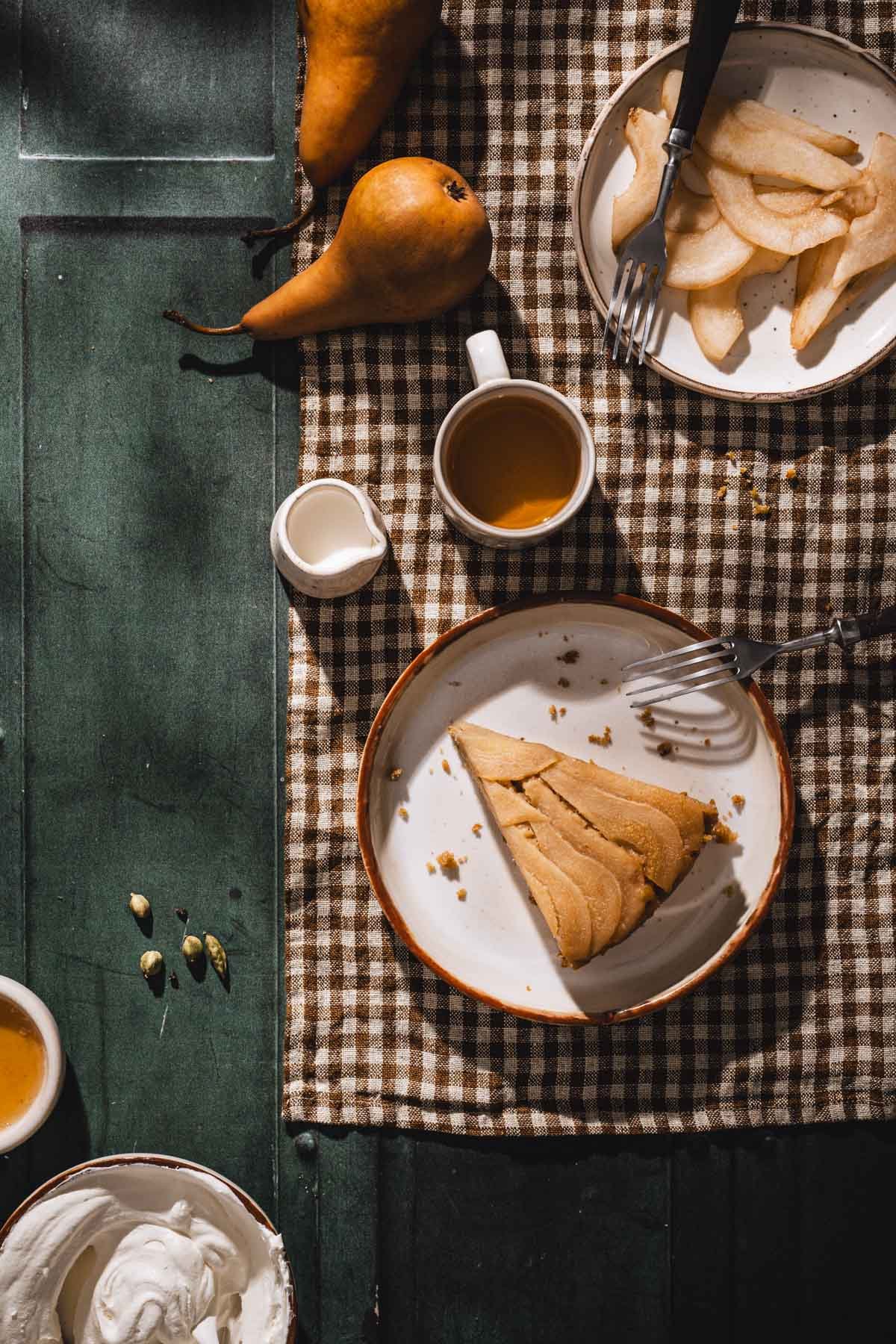
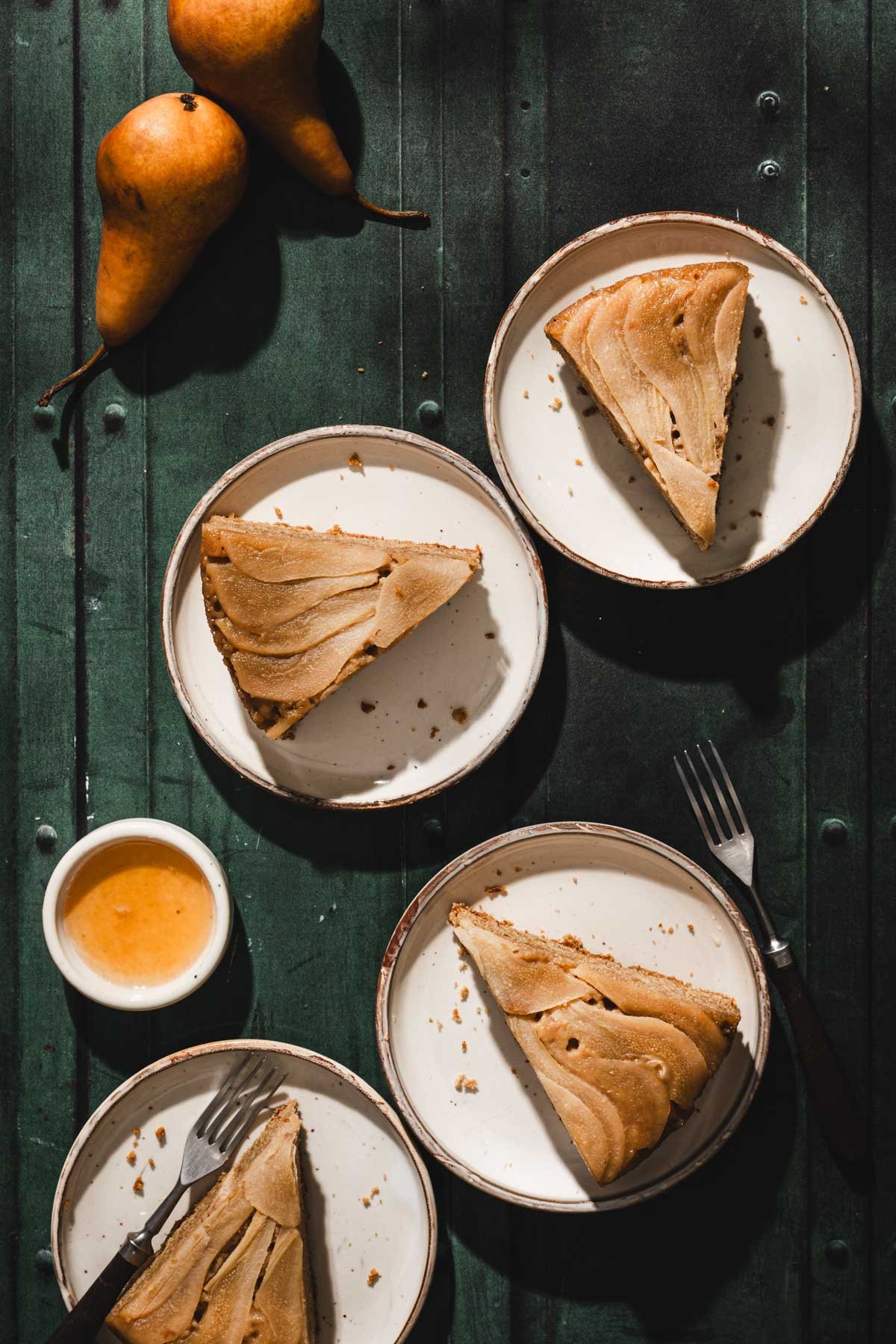
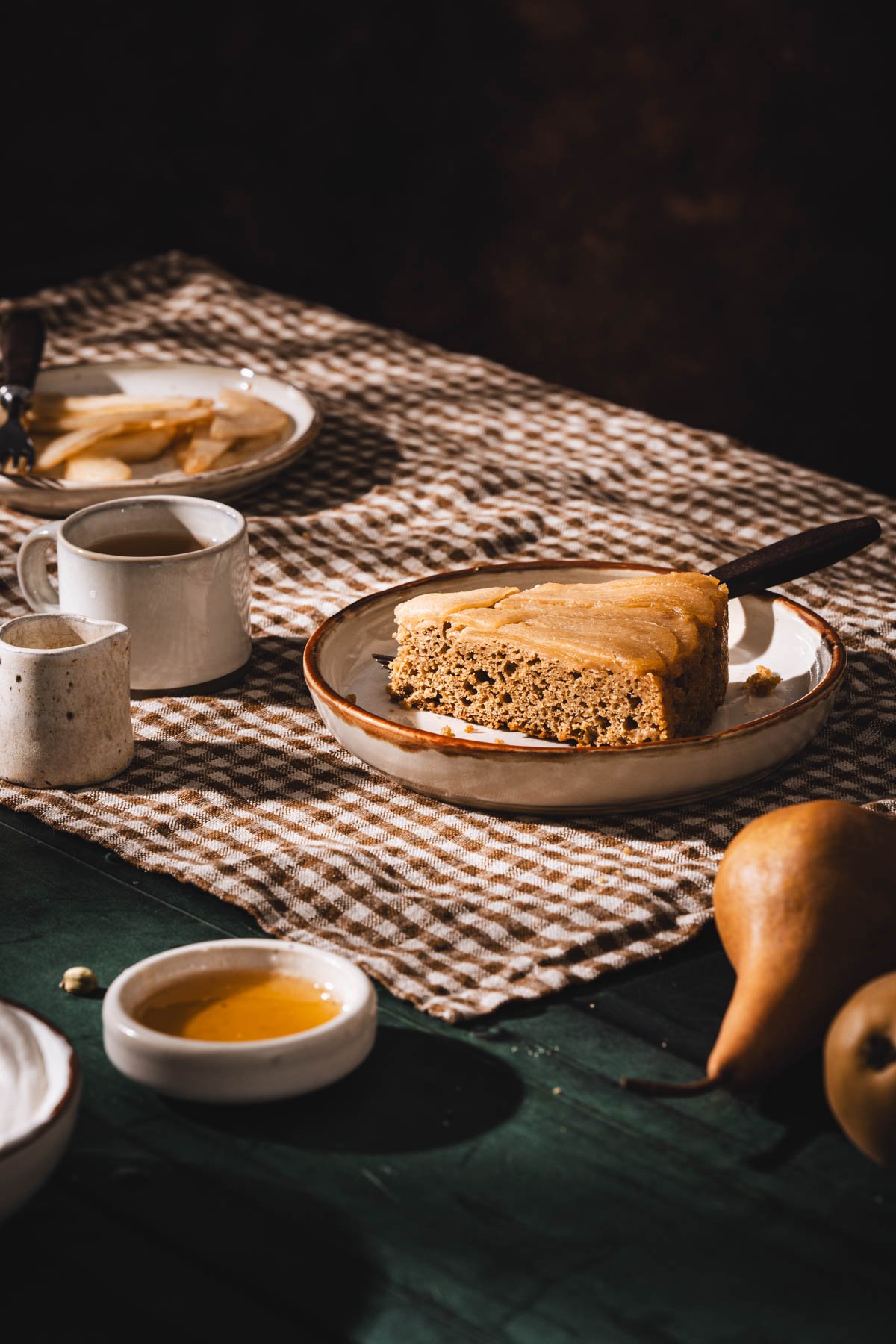
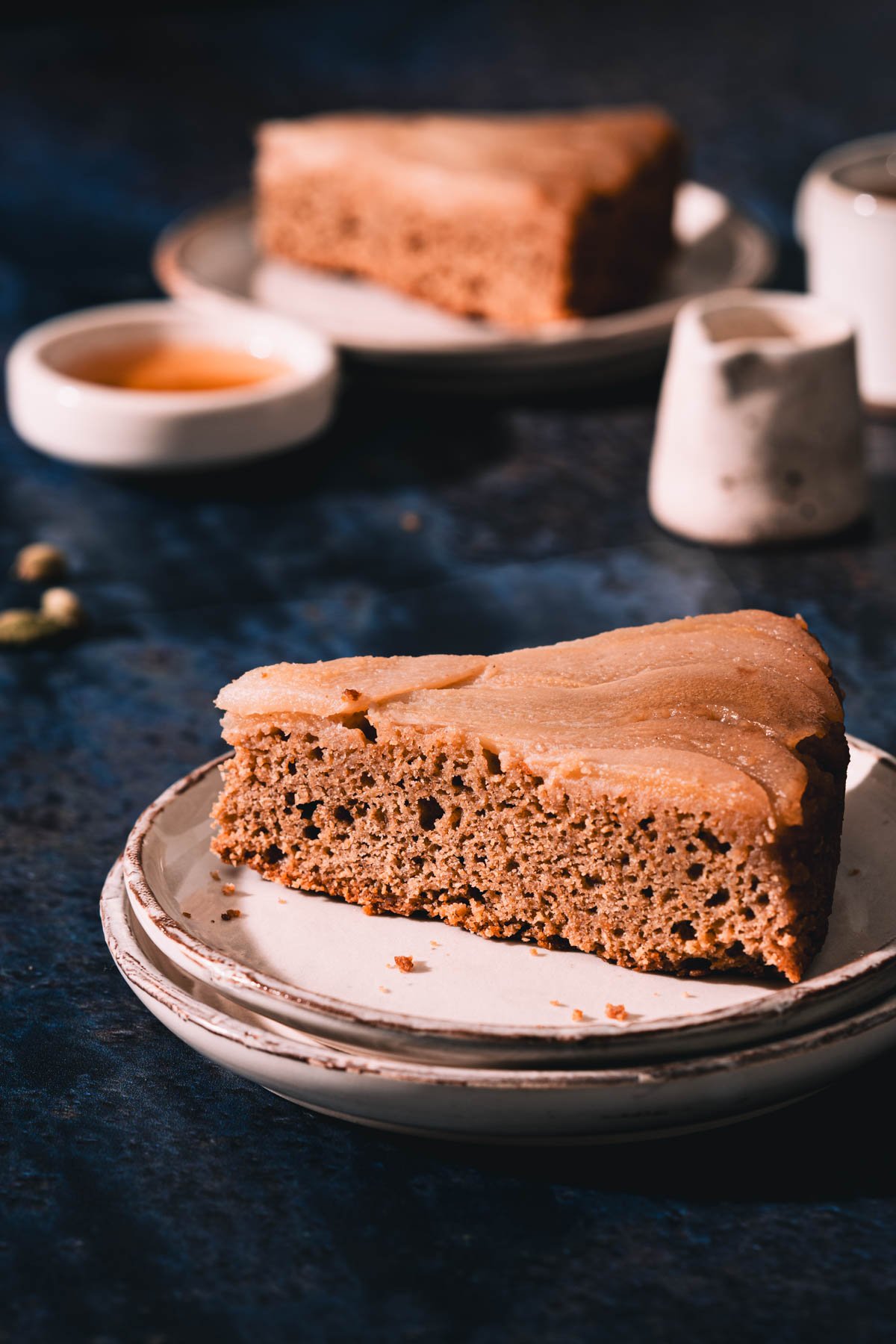
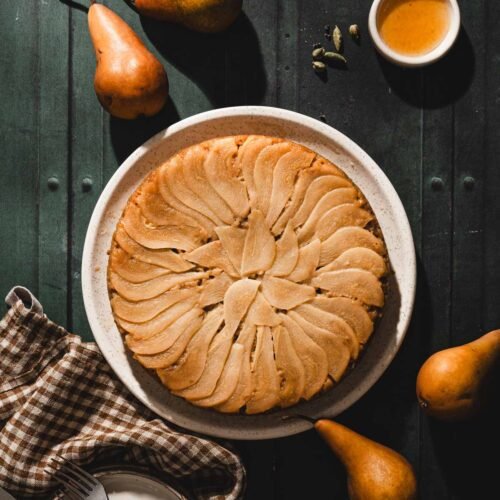
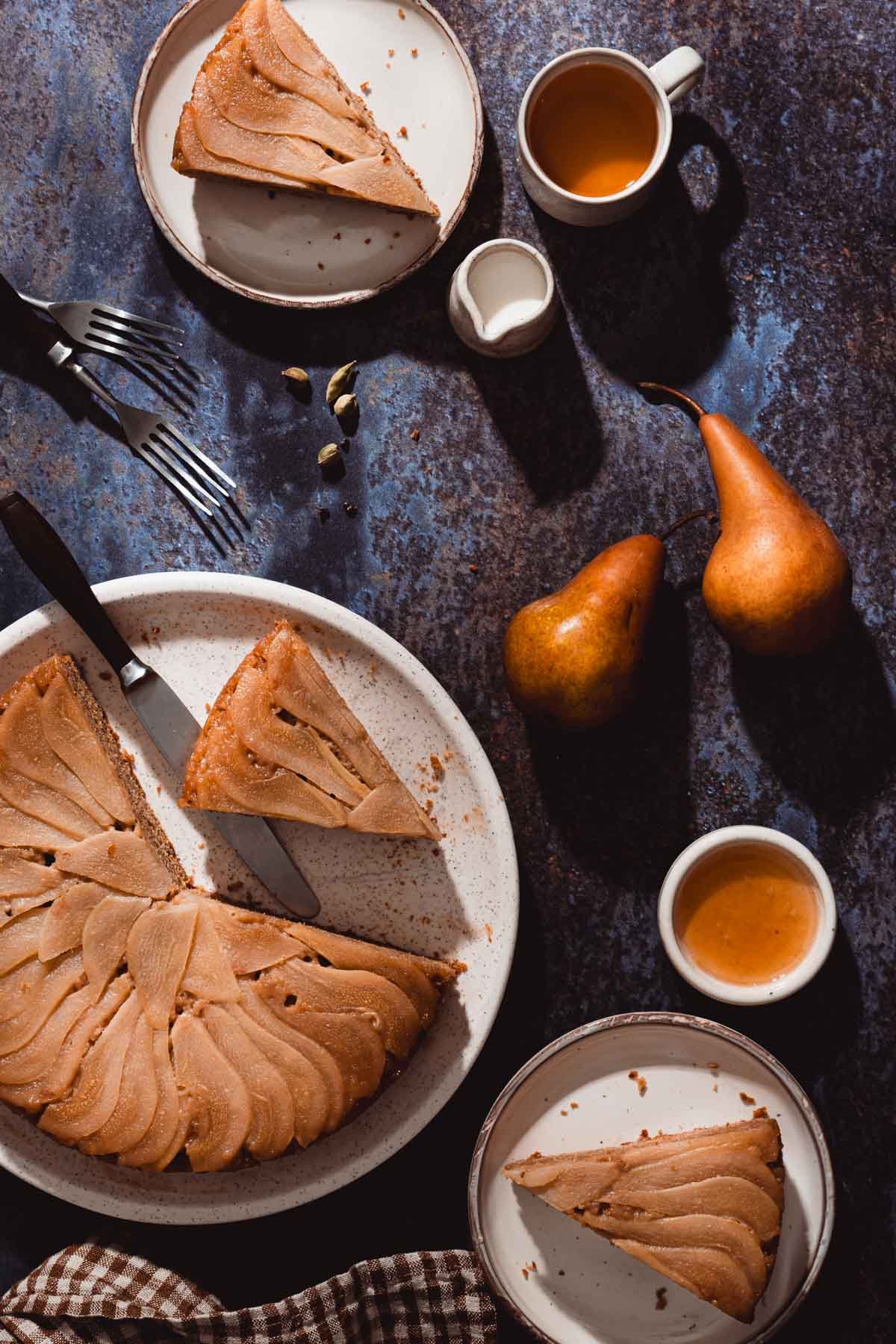
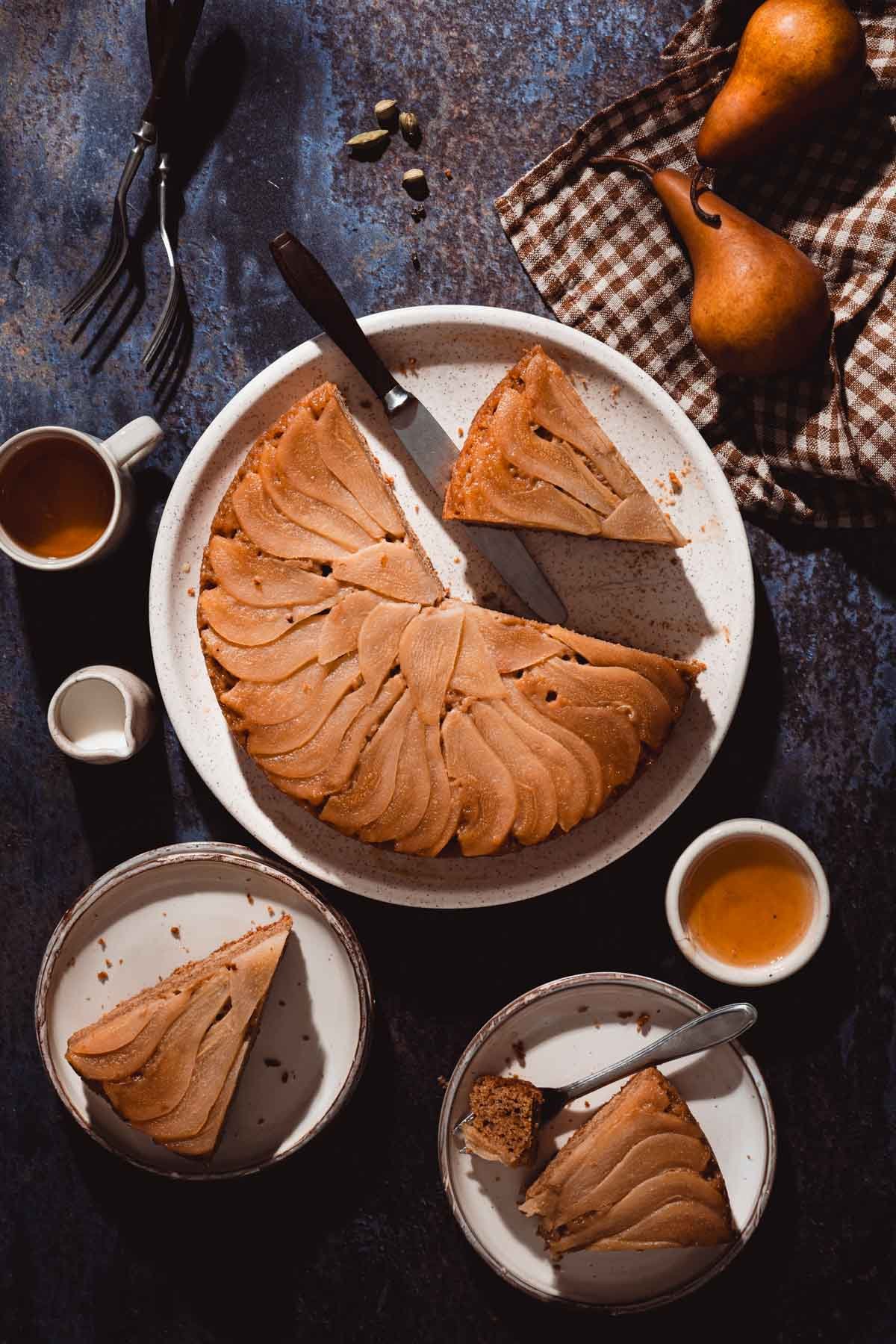
This Brown Butter, Honey & Pear Upside-Down Cake puts firm Bosc pears front and center. Layer them over a buttery honey topping, then cover with a tender sour cream cake made with browned butter, coconut sugar, and warm cardamom. A little rye flour adds an earthy note that balances the sweetness without making the cake taste heavy.
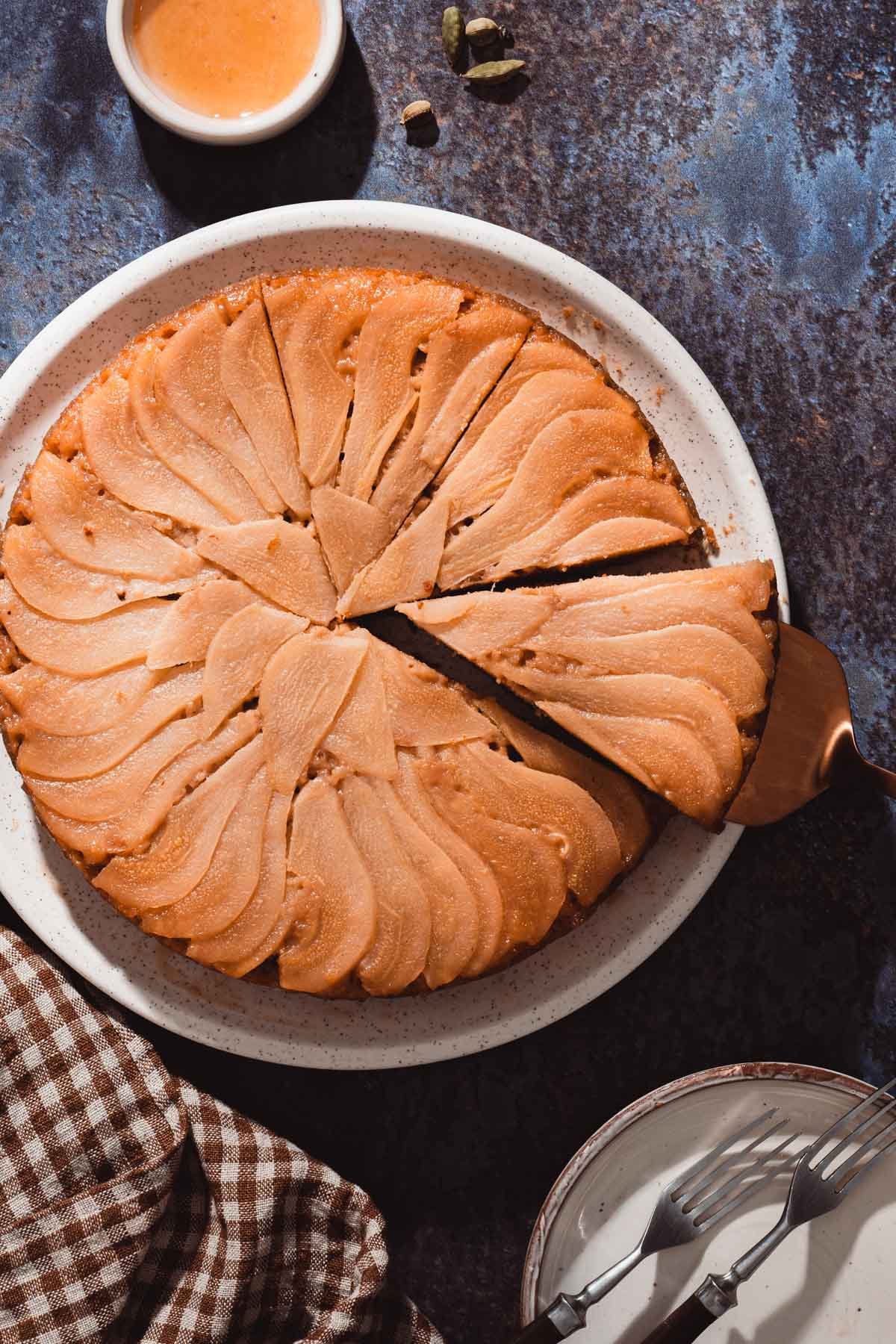
It’s a seasonal twist on my upside-down cake series, with familiar ingredients and a slightly unexpected combination. Turn it out of the pan, let those glossy pears do their thing, and you’ve got a cake that looks like you put in considerably more effort than you actually did.
Quick Look at this Recipe:
Other upside-down cakes you should try:
Key Ingredients, Variations and Substitutions
Bosc Pears – firm, slightly grainy, and they hold their shape beautifully when baked. They don’t turn to mush under heat, which is exactly what you want for an upside-down cake where the fruit is front and center. Look for pears that give just slightly at the stem but are still mostly firm. If you can’t find Bosc, Anjou pears are your next best option. Bartletts can work but go softer, so watch your bake time. Avoid any pear that’s already very ripe.
Orange Blossom Honey – floral and aromatic, this honey is what gives the topping its distinctive brightness. It doesn’t taste like orange exactly, more like the idea of spring in a jar. If you can’t find orange blossom honey, any good-quality floral honey works. Acacia is lovely here too. The mild honey (clover or similar) balances it out so the topping isn’t overwhelmingly perfumed
Light Rye Flour – this small addition makes the cake taste noticeably more complex. Rye has an earthy, slightly tangy depth that pairs really naturally with pears and honey. You only need 45 g of it, so the cake doesn’t taste like rye bread – it just tastes better than a cake made with all-purpose flour alone. If you don’t keep rye flour on hand, you can substitute whole wheat flour or use all-purpose. The texture will be slightly different but still good.
Brown Butter – the base of the batter and probably the most important step in this recipe. Start with 150 g and cook it until the milk solids turn golden and the whole kitchen smells nutty. You end up using 115 g of finished brown butter in the batter. Don’t skip this step and don’t rush it – this is where most of the flavor lives.
Other ingredients: coconut sugar (swap brown sugar), sour cream (swap Greek yogurt), eggs, vanilla extract, baking powder, ground cardamom, fine sea salt, lemon juice.
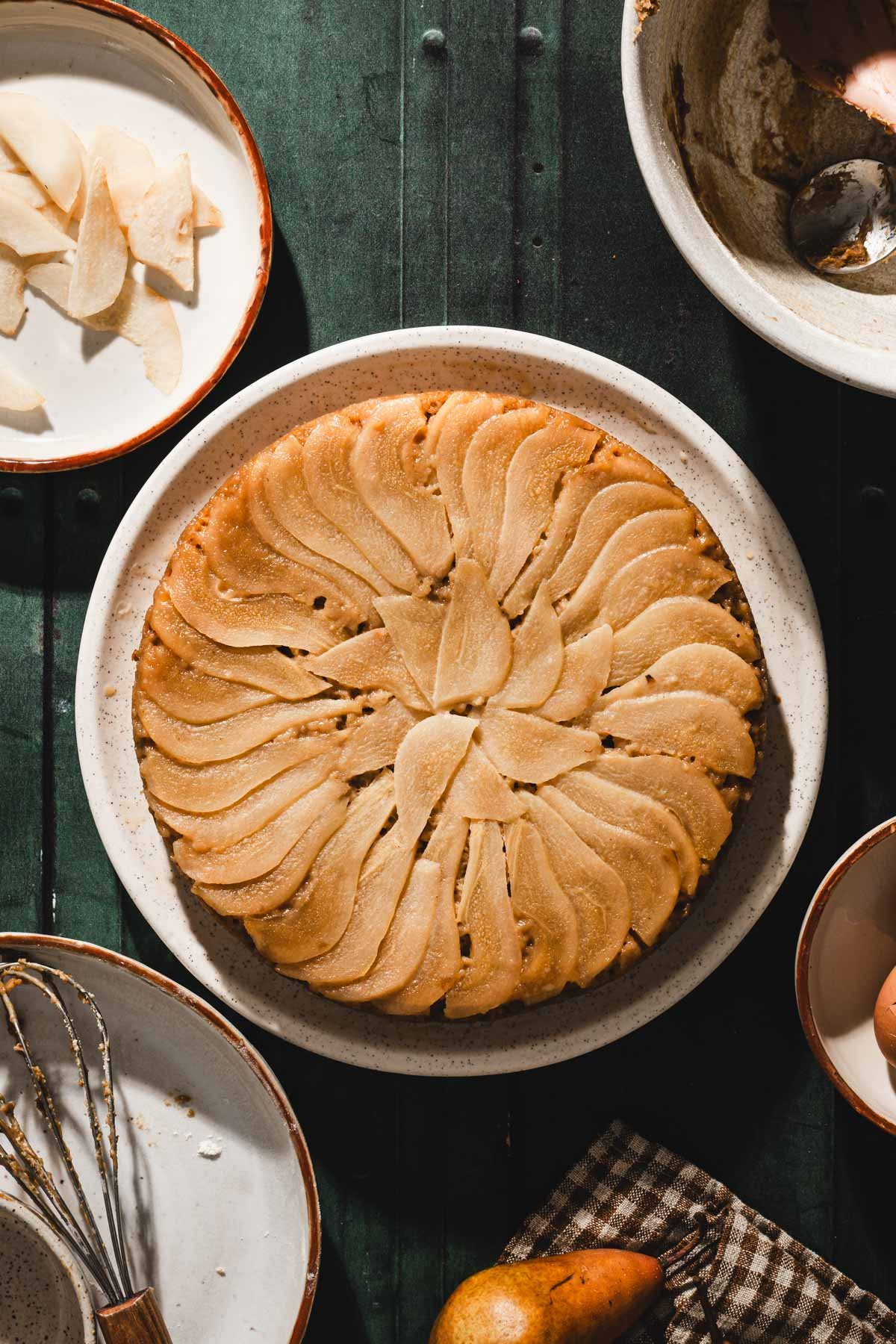
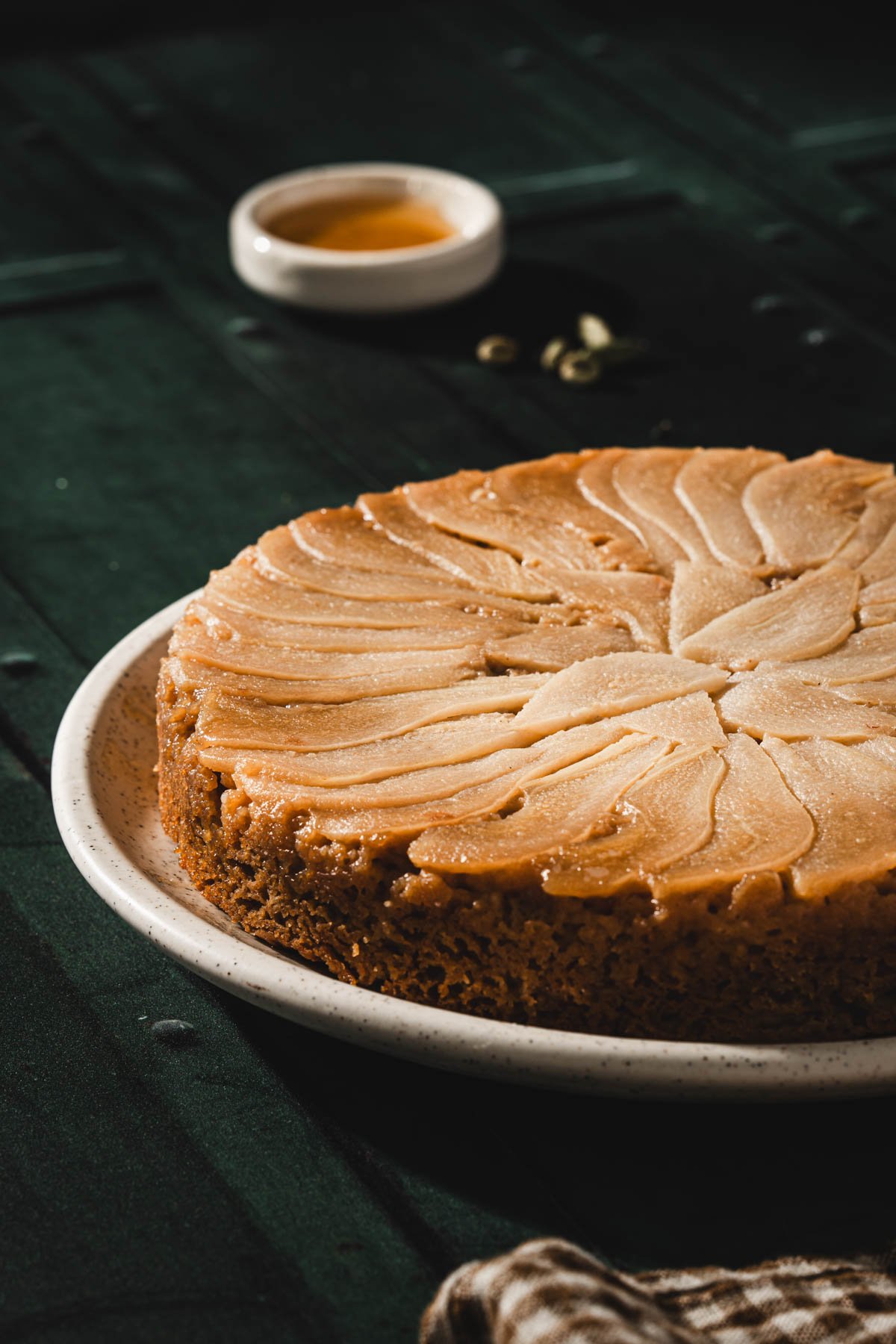
Equipment you will need
- 9-inch round cake pan (at least 2 inches deep)
- 9-inch parchment paper circle
- Light-colored saucepan (for browning butter)
- Small saucepan (for the honey topping)
- Large bowl
- Medium mixing bowl
- Whisk and spatula
- Kitchen scale
- Thin knife (for loosening edges)
- Rimmed serving plate
- Wire rack
- Oven mitts
Top Tips
Weigh your pears after prepping, not before. You need 450 g of peeled, cored pears. A whole pear weighs more than what you’ll actually use, so weigh after you’ve done the work.
Cool the brown butter to lukewarm before using. Hot butter scrambles eggs. Give it time to cool until it’s warm to the touch but not hot. Stir it before measuring to distribute all those toasty browned bits evenly through the batter.
Don’t let the honey topping sit too long before adding the pears. Pour it, spread it, and arrange the pears right away. It firms up as it cools, so press the pears into it while it’s still fluid.
The 15-minute rest before flipping matters. Too soon and the honey topping runs everywhere. Too late and the cake can stick. Set a timer.
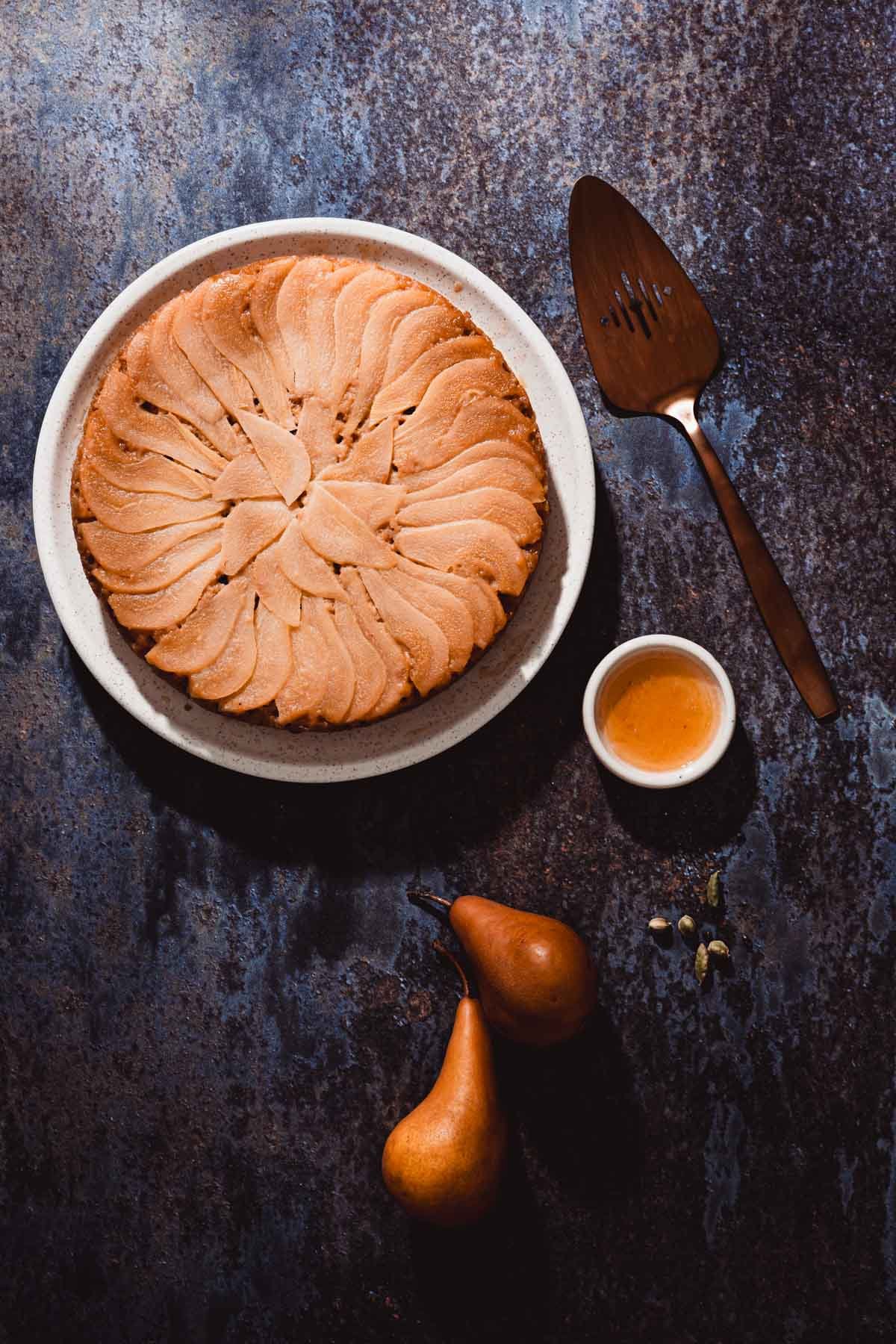
Step-by-step instructions
- Preheat the oven to 350°F (175°C), with a rack in the center.
- Lightly butter the bottom and sides of a 9-inch round metal cake pan, at least 2 inches deep.
- Line the bottom of the pan with parchment and lightly butter the parchment.
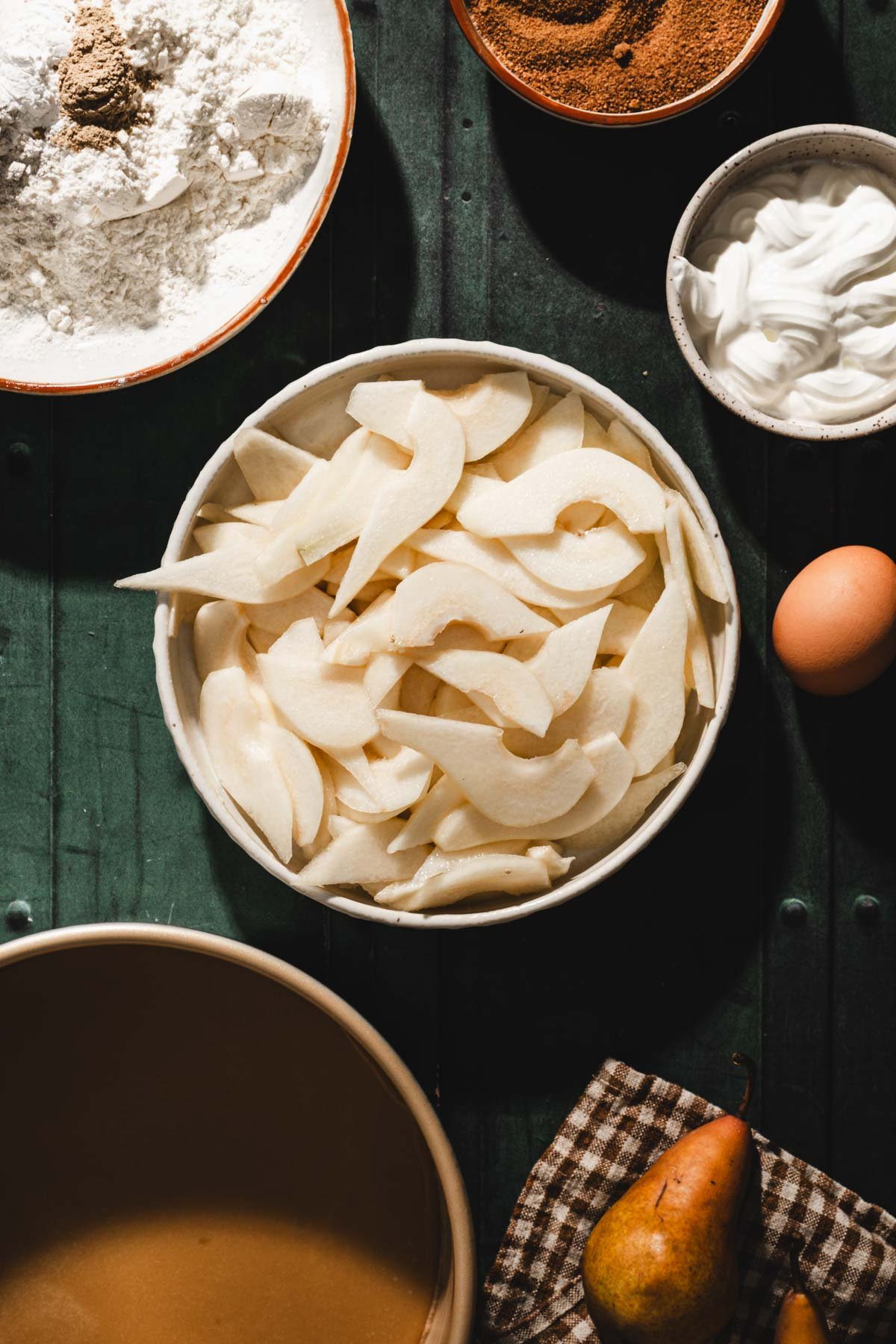
- Peel the Bosc pears, cut them in half lengthwise, and remove the cores.
- Weigh out 450 g of prepared pears.
- Slice the pears approximately 5 mm (¼ inch) thick.
- Gently toss with 1 tsp lemon juice and set aside.
- Place 150 g unsalted butter in a light-colored saucepan over medium heat.
- Cook, stirring and scraping the bottom regularly, until the butter foams, the milk solids turn golden brown, and the butter smells nutty.
- Immediately pour the butter and all the browned bits into a heatproof bowl.
- Let cool until lukewarm, not hot.
- Stir to distribute the browned bits, then weigh out 115 g into a large mixing bowl.
- Reserve any excess for another use. If you have slightly less than 115 g, add enough melted butter to reach that weight.
- In a small saucepan, combine 60 g unsalted butter, 60 g orange blossom honey, and 40 g mild honey.
- Heat over medium-low heat, stirring until the butter melts and the mixture combines.
- Once it begins to bubble gently, cook for 1–2 minutes, stirring frequently. Remove from the heat.
- Stir in ¼ tsp ground cardamom, ½ tsp vanilla extract, and a pinch of fine sea salt.
- Stir well immediately before pouring. The topping should stay fluid and not turn into a thick caramel.
- Pour the warm honey topping into the prepared cake pan and spread it evenly across the bottom.
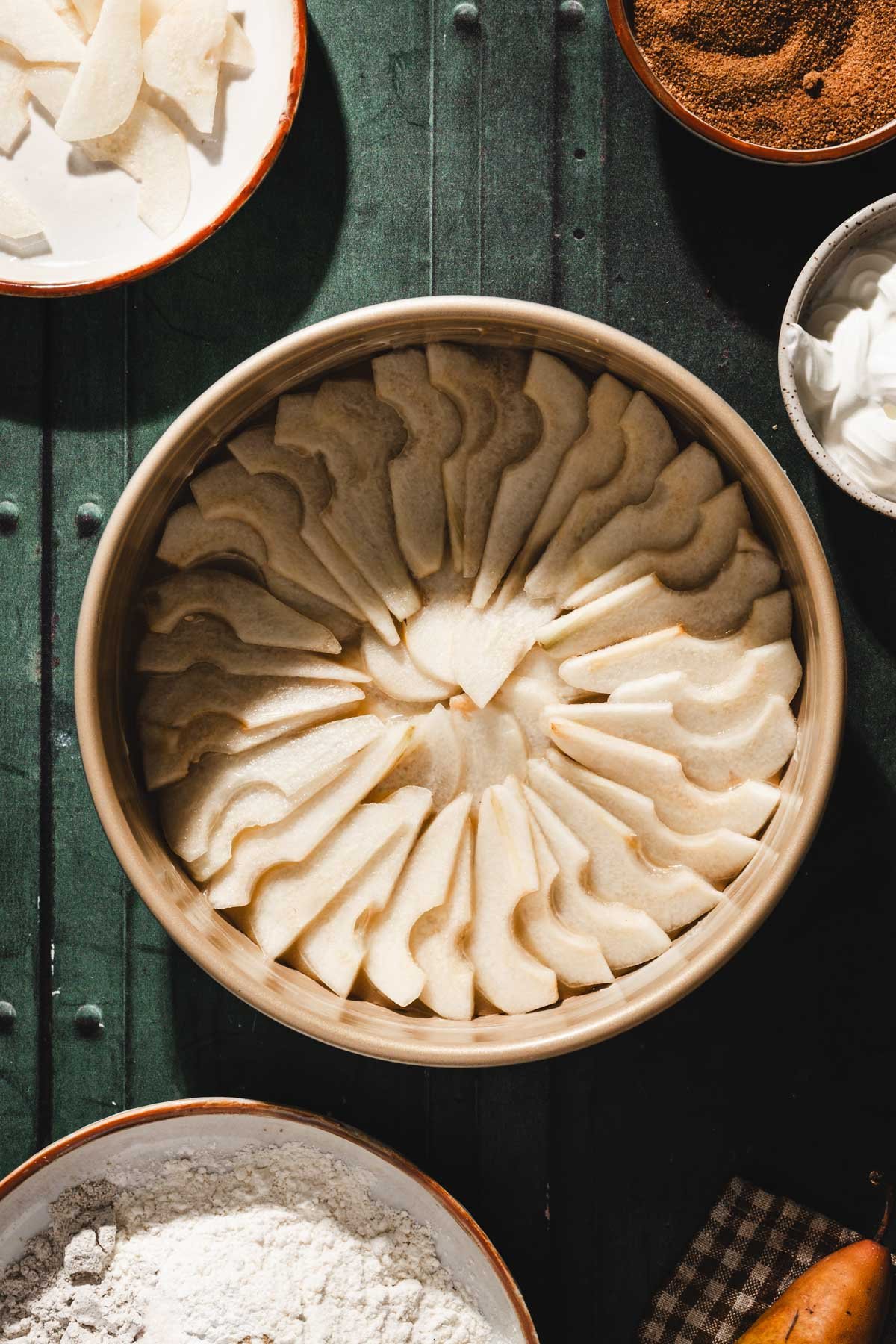
- Arrange the pear slices in snug, overlapping circles, starting at the outer edge and working toward the center.
- Distribute the slices evenly. Avoid creating a thick mound in the middle.
- Set the pan aside while you prepare the cake batter.
- In a medium bowl, whisk together 145 g all-purpose flour, 45 g light rye flour, 2 tsp baking powder, ½ tsp ground cardamom, and ½ tsp fine sea salt.
- Whisk thoroughly to distribute the baking powder and spices evenly.
- To the bowl with 115 g of lukewarm browned butter, add 110 g of coconut sugar.
- Whisk until combined. The sugar doesn’t need to dissolve completely.
- Add 2 room-temperature eggs, one at a time, whisking well after each addition.
- Whisk in 1 tsp of vanilla extract and 130 g of room-temperature sour cream.
- Mix until reasonably uniform.
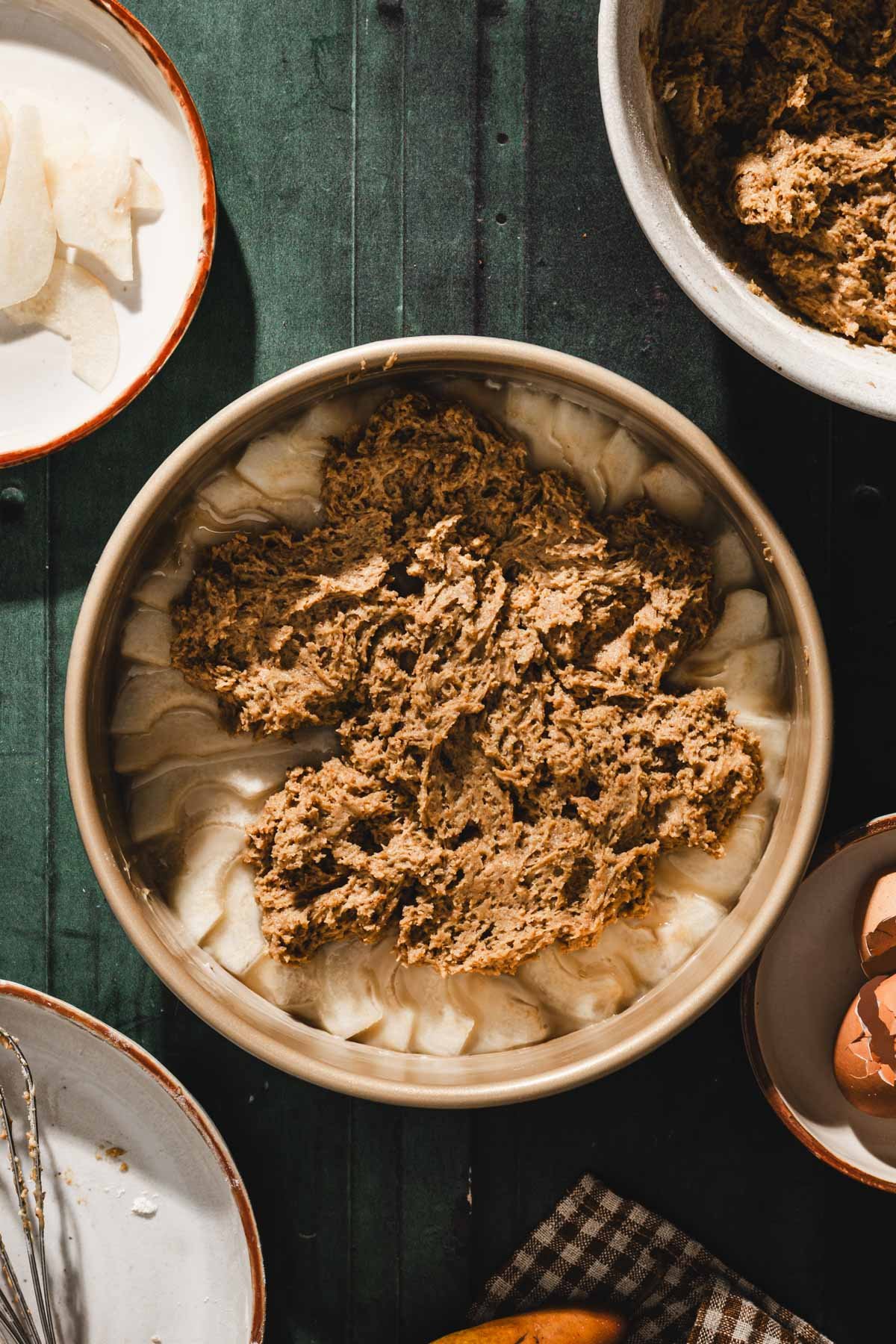
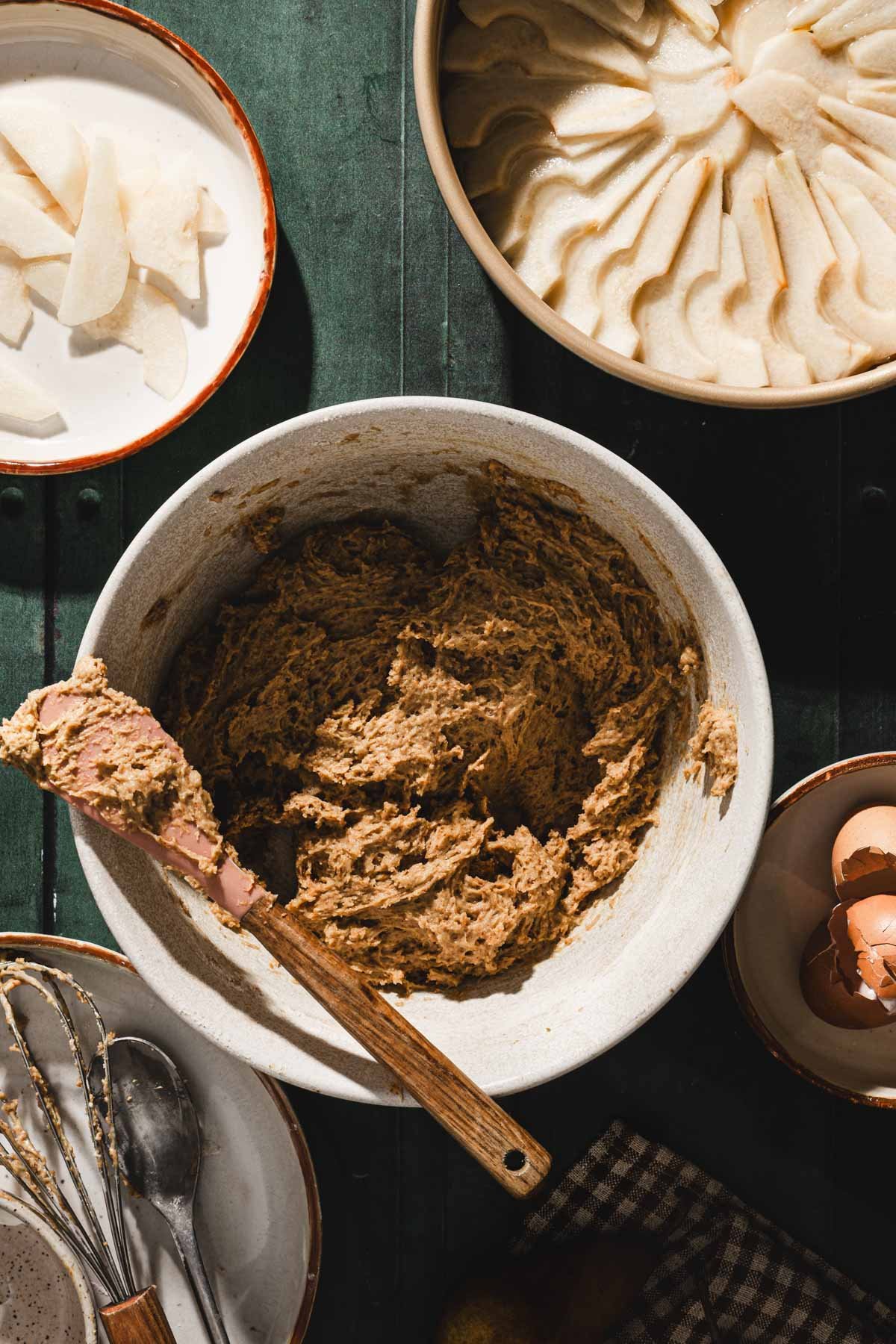
- Add the dry ingredients to the wet ingredients.
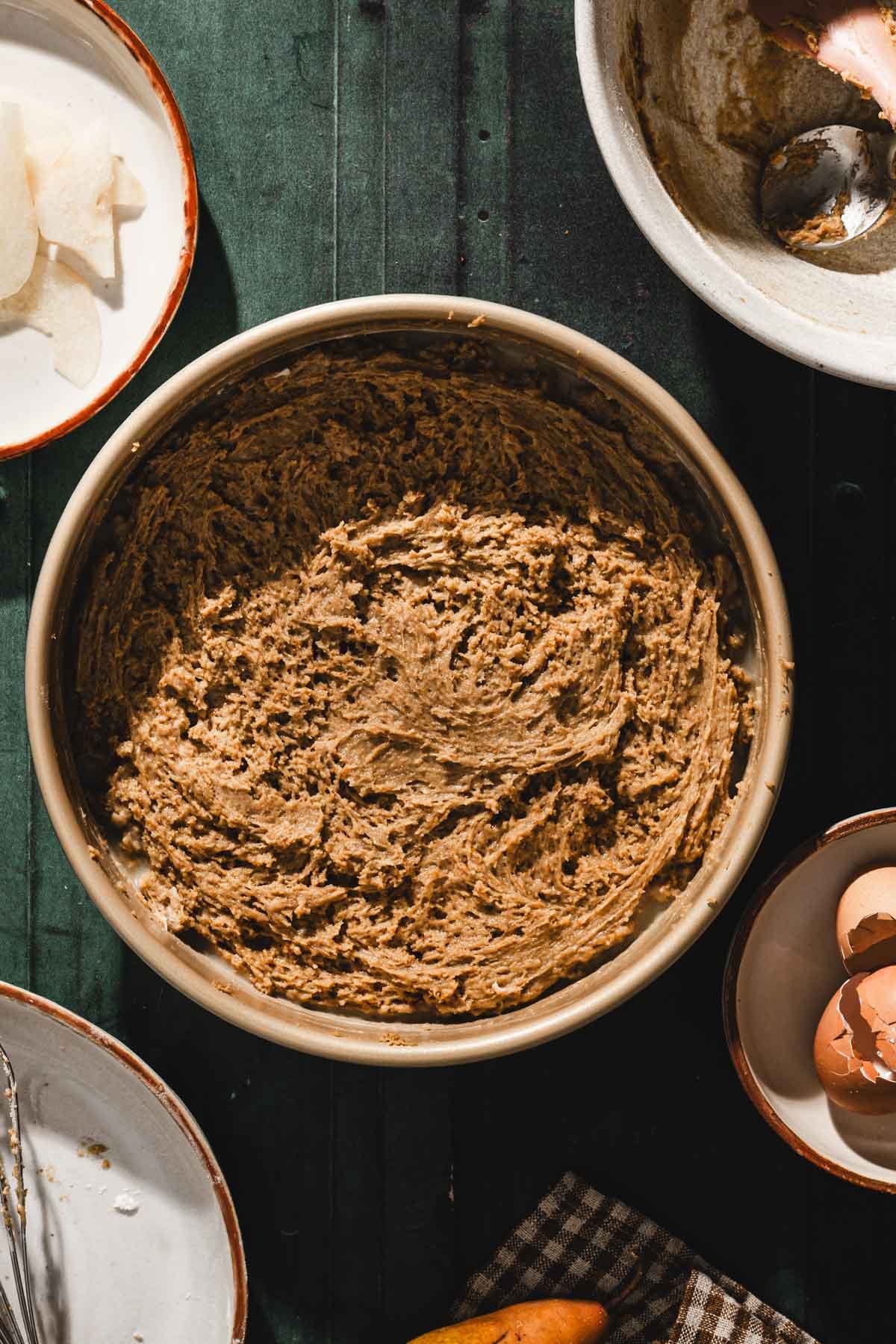
- Fold gently with a spatula, scraping the bottom and sides of the bowl, just until no dry flour remains.
- Spoon the batter in small dollops evenly over the pears.
- Tap the pan lightly on the counter once or twice to settle the batter.
- Bake on the center rack for approximately 45–50 minutes, starting to check at 40 minutes.
- The cake is ready when the center is set and springs back lightly when touched, and a toothpick inserted comes out clean or with a few moist crumbs.
- Avoid pushing the toothpick all the way into the pear and honey layer, which will remain moist.
- If the top browns before the center is done, loosely cover with foil and continue baking.
- Place the pan on a wire rack and let the cake rest for 15 minutes.
- Run a thin knife around the edges to loosen the cake.
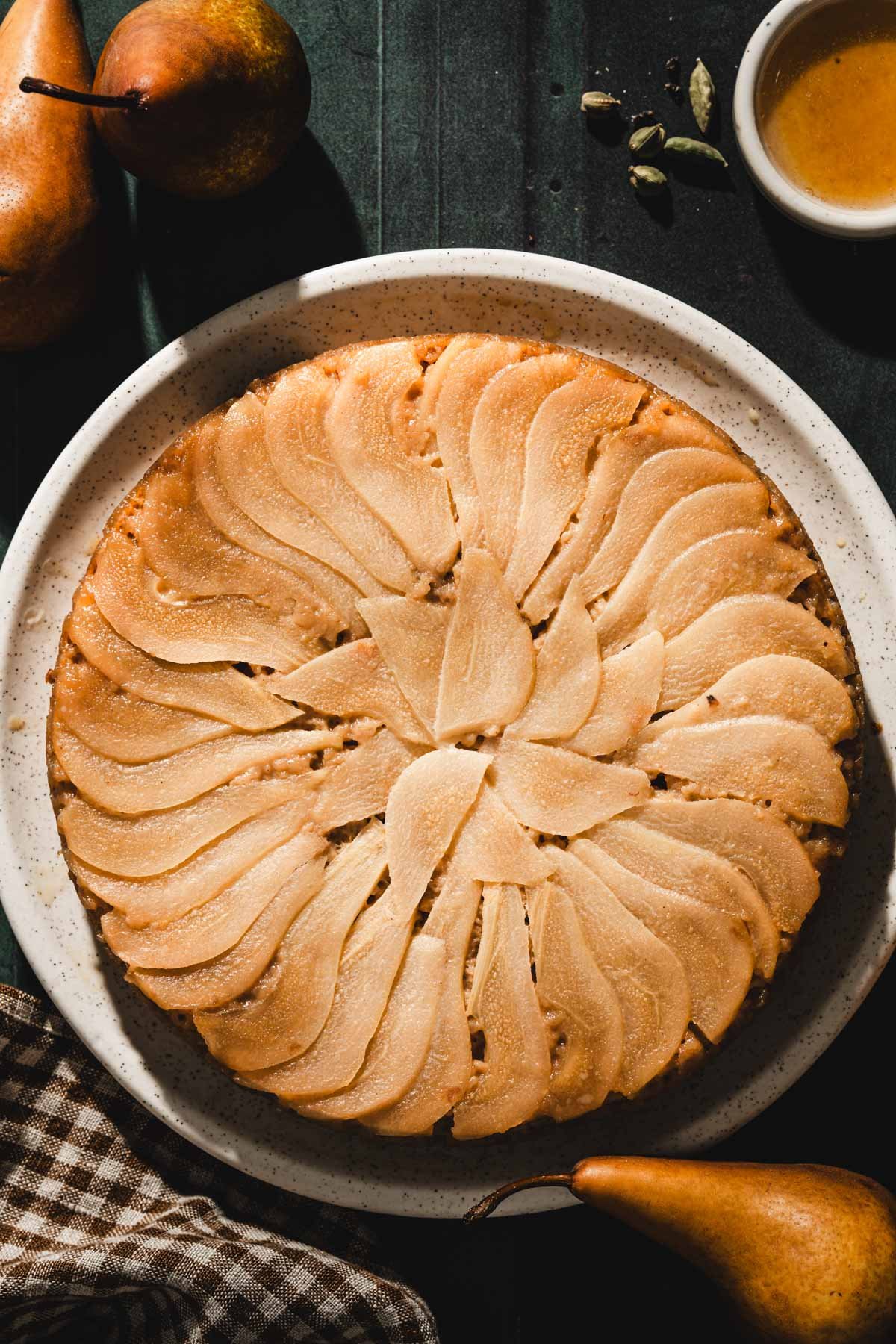
- Place a rimmed serving plate, wider than the pan, upside down over it.
- Wearing oven mitts, hold the plate and pan securely together and carefully invert.
- Lift the pan slowly, then gently peel away the parchment.
- Reposition any displaced pear slices while the topping is still warm.
- Let the cake cool on the serving plate for at least 15 minutes before slicing.
Best way to enjoy
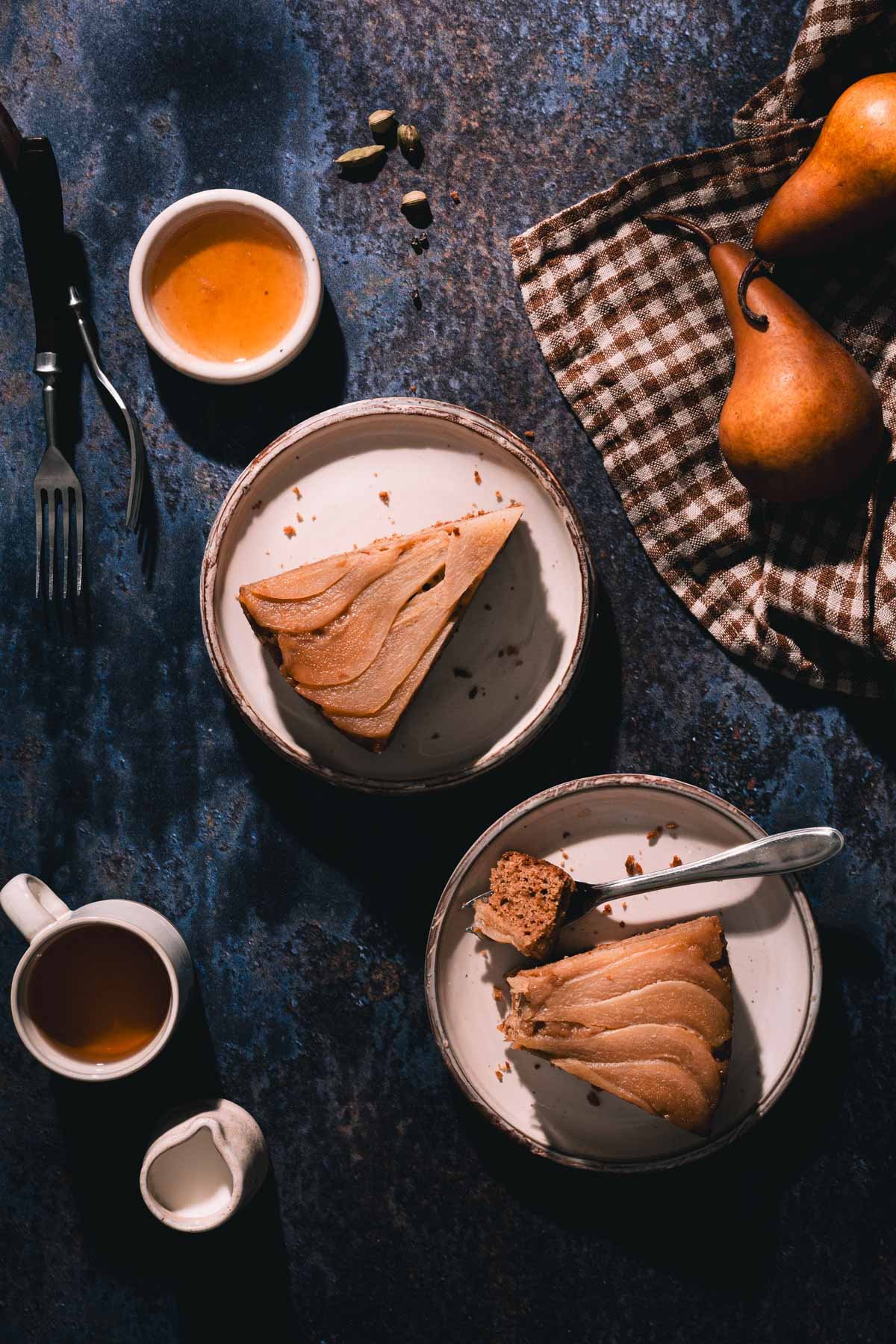
Slightly warm with a spoonful of crème fraîche or whipped cream
With a scoop of vanilla ice cream if you want it a little more decadent
You may also like:
Storage instructions, reheating
Room temperature: loosely covered for up to 1 day. Best if enjoyed the same day or the morning after.
Refrigerator: cover and refrigerate for up to 3 days. Bring slices to room temperature before serving, or warm them briefly in a low oven to soften the crumb and loosen the honey layer.
Freezing: The cake freezes well. Wrap individual slices tightly and freeze for up to 1 month. Thaw overnight in the refrigerator or at room temperature. The honey topping softens back up nicely once warmed.
Reheating: a quick 20 to 30 seconds in the microwave or 5 minutes in a 300°F oven brings the crumb back to life. Worth the extra step.
Easy Brown Butter Pear Upside-Down Cake

Equipment
- 9-inch round metal cake pan, at least 2 inches deep
- parchment paper
- Light-colored saucepan (for browning butter)
- Small saucepan (for the honey topping)
- large mixing bowl
- Medium mixing bowl
- Whisk and spatula
- kitchen scale
- Thin knife (for loosening edges)
- Rimmed serving plate
- wire rack
- oven mitts
Ingredients
Honey topping
- 60 grams unsalted butter
- 60 grams orange blossom honey
- 40 grams mild honey such as clover
- ½ teaspoon vanilla extract
- Pinch of sea salt
Pear layer
- 450 grams firm Bosc pears weighed after peeling and coring
- 1 teaspoon lemon juice
Brown butter and rye cake batter
- 150 grams unsalted butter for browning (you’ll use 115 g finished browned butter)
- 145 grams all-purpose flour
- 45 grams light rye flour
- 2 teaspoons baking powder approximately 8 g
- ½ teaspoon ground cardamom
- ½ teaspoon fine sea salt
- 110 grams coconut sugar
- 2 large eggs at room temperature
- 1 teaspoon vanilla extract
- 130 grams full-fat sour cream at room temperature
For preparing the pan
- Softened butter
Instructions
- Preheat the oven to 350°F (175°C), with a rack in the center.
- Lightly butter the bottom and sides of a 9-inch round metal cake pan, at least 2 inches deep.
- Line the bottom with a parchment circle.
- Peel the Bosc pears, cut them in half lengthwise, and remove the cores. Weigh out 450 grams firm Bosc pears.
- Slice the pears approximately 5 mm (¼ inch) thick.
- Gently toss with 1 teaspoon lemon juice and set aside.
- Place 150 grams unsalted butter in a light-colored saucepan over medium heat.
- Cook, stirring and scraping the bottom regularly, until the butter foams, the milk solids turn golden brown, and the butter smells nutty.
- Immediately pour the butter and all the browned bits into a heatproof bowl.
- Let cool until lukewarm, not hot.
- Stir to distribute the browned bits, then weigh out 115 g into a large mixing bowl.
- Reserve any excess for another use. If you have slightly less than 115 g, add enough melted butter to reach that weight.
- In a small saucepan, combine 60 grams unsalted butter, 60 grams orange blossom honey and 40 grams mild honey.
- Heat over medium-low heat, stirring until the butter melts and the mixture combines.
- Once it begins to bubble gently, cook for 1–2 minutes, stirring frequently. Remove from the heat.
- Stir in ½ teaspoon vanilla extract and a Pinch of sea salt.
- Stir well immediately before pouring. The topping should remain fluid, not turn into a thick caramel.
- Pour the warm honey topping into the prepared cake pan and spread it evenly across the bottom.
- Arrange the pear slices in snug, overlapping circles, starting at the outer edge and working toward the center.
- Set the pan aside while you prepare the batter.
- In a medium bowl, whisk together 145 grams all-purpose flour, 45 grams light rye flour, 2 teaspoons baking powder, ½ teaspoon ground cardamom, and ½ teaspoon fine sea salt.
- Whisk thoroughly to distribute the baking powder and spices evenly.
- To the bowl with 115 g of lukewarm browned butter, add 110 grams coconut sugar.
- Whisk until combined. The sugar doesn’t need to dissolve completely.
- Add 2 large eggs, one at a time, whisking well after each addition.
- Whisk in 1 teaspoon vanilla extract and 130 grams full-fat sour cream.
- Mix until reasonably uniform.
- Add the dry ingredients to the wet ingredients.
- Fold gently with a spatula, scraping the bottom and sides of the bowl, just until no dry flour remains.
- Spoon the batter in small dollops over the arranged pears.
- Gently spread into an even layer without disturbing the pear arrangement.
- Tap the pan lightly on the counter once or twice to settle the batter.
- Bake on the center rack for approximately 45–50 minutes, starting to check at 40 minutes.
- The cake is ready when the center is set and springs back lightly when touched, and a toothpick inserted into the cake comes out clean or with a few moist crumbs.
- Avoid pushing the toothpick all the way into the pear and honey layer, which will remain moist.
- If the top browns before the center is done, loosely cover with foil and continue baking.
- Place the pan on a wire rack and let the cake rest for 15 minutes.
- Run a thin knife around the edges to loosen the cake.
- Place a rimmed serving plate, wider than the pan, upside down over it.
- Wearing oven mitts, hold the plate and pan securely together and carefully invert.
- Lift the pan slowly, then gently peel away the parchment.
- Reposition any displaced pear slices while the topping is still warm.
- Let the cake cool on the serving plate for at least 15 minutes before slicing.
Notes
Nutrition
Did you make this recipe?
Tag me @sylwiavaclavekphotography or tag me using #myomnikitchen so I can see your creations! You can also leave a comment below!
Conclusion
This pear upside-down cake is a lovely way to bring seasonal fruit into a simple homemade dessert. The honey-butter topping gives the pears a beautiful glossy finish, while the brown butter, rye, and sour cream cake underneath brings richness and a little warmth.
Serve it slightly warm or at room temperature, on its own or with a spoonful of crème fraîche or lightly whipped cream. And if you have a slice left the next day, consider that a very good breakfast decision. I’m not here to judge.
FAQ
Can I use regular all-purpose flour instead of rye?
Yes. Replace the 45 g light rye flour with the same amount of all-purpose flour. The cake will be a little lighter in flavor but still tender and good. Whole wheat flour is also a solid swap if you want to keep some of that earthy depth.
What if I don’t have orange blossom honey?
Any floral, mild honey works here. Acacia is a lovely choice. Avoid very strong or dark honeys like buckwheat honey, as they can overpower the delicate pear flavor.
Why do I need to start with 150 g of butter and only use 115 g?
Butter loses water as it browns, so you lose weight during cooking. Starting with 150 g ensures you end up with enough finished brown butter. You’ll use 115 g in the batter – any extra is a cook’s treat.
My cake stuck to the pan. What went wrong?
Two things usually cause this: not enough butter on the pan and parchment, or flipping the cake too early or too late. Fifteen minutes is the target resting time. Also make sure your pan is at least 2 inches deep so the honey topping doesn’t bubble over and bake onto the sides.
Can I use a different pan?
A 9-inch round metal pan is ideal. Avoid glass or ceramic, as they don’t conduct heat the same way. Springform pans are also a no – the honey topping will leak out.
Hungry for more? Check out the latest posts from My Omni Kitchen.
- Easy Brown Butter Pear Upside-Down Cake
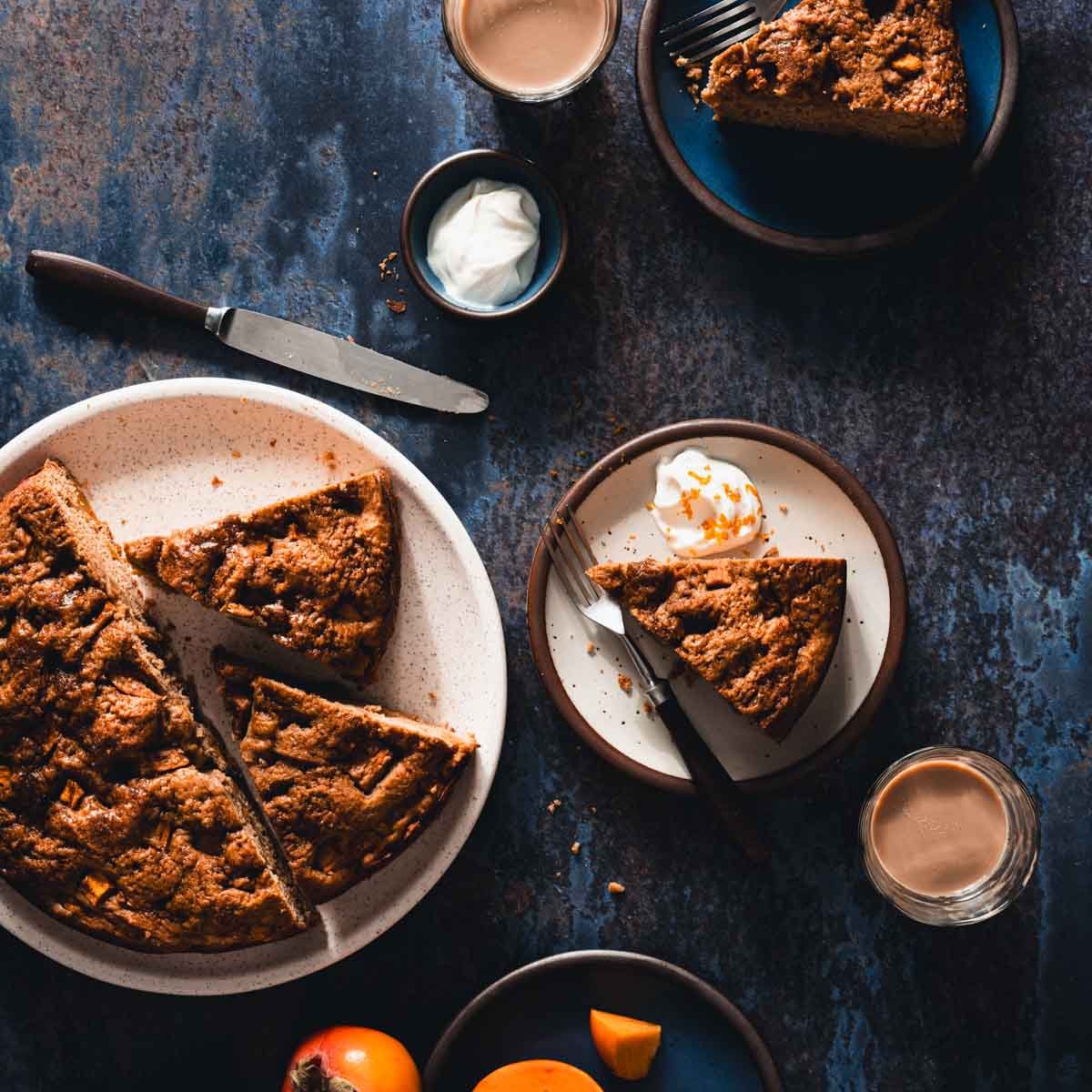
- One-Bowl Brown Butter Persimmon Cake
- Gluten-Free Buckwheat Stuffing With Mushrooms And Leeks
- Sauerkraut Skillet With Apples, Caraway and Brown Butter
- Rye Bread with Buckwheat And Mushrooms Stuffing Recipe